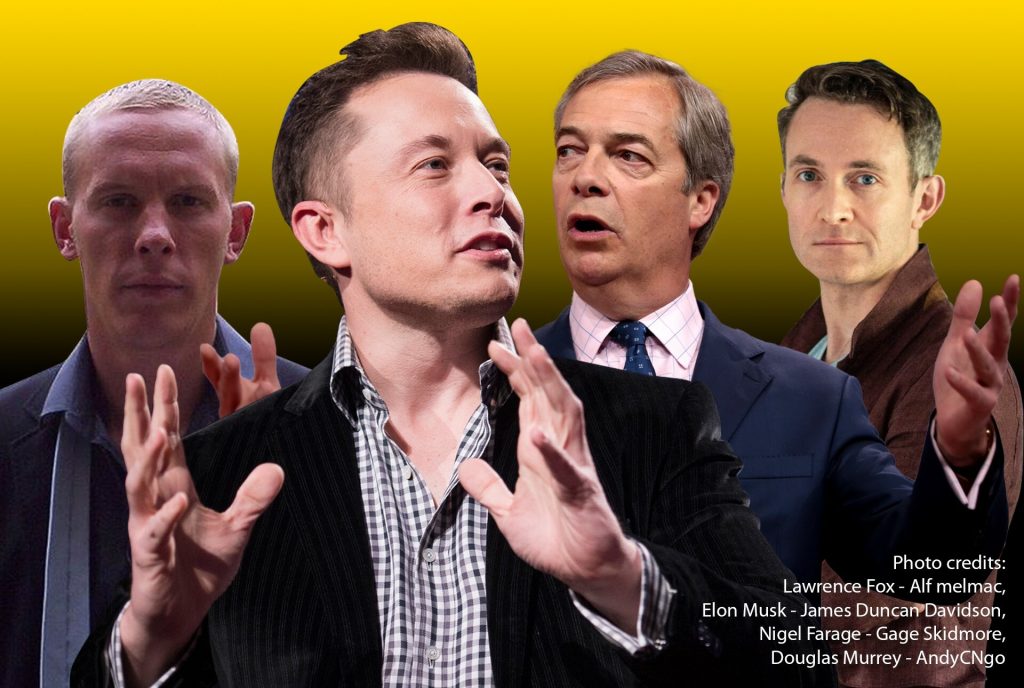
This week news has emerged that Elon Musk has sent a threatening legal letter to Center For Countering Digital Hate (CCDH), accusing it of producing research that is “false, misleading, or both,” and that their findings “are not supported by anything that could credibly be called research.” One comically ironic line accuses CCDH of “actively working to prevent free expression.”
Musk seems to be making a habit of attacking NGOs critical of him and Twitter having previously criticised the Anti-Defamation League after they spoke out against his comment’s about George Soros.
Most concerning however is that the letter to CCDH, sent by Alex Spiro of US law firm Quinn Emanuel Urquhart and Sullivan, states that: “Twitter will employ any and all legal tools at its disposal to prevent false or misleading claims from harming its users, platform, or business.” The irony of Musk accusing others of spreading false and misleading information considering his own track record should not be lost on anyone.
The incident has left many scratching their head as to how such a legal threat sits alongside Musk’s declaration that he is a “free speech absolutist.” The simple explanation is that he’s not one.
Musk wants the right to say whatever he wants without consequence, and allows far-right activists to spread hate speech on Twitter, but clearly does not think those who criticise him should be afforded the same liberties. Criticise Musk in a way that threatens his bottom line and it seems you can expect a legal letter.
Once again, this incident highlights the staggering hypocrisy of so many “defenders of free speech” and anti-”cancel culture” crusaders. In recent years, many who have sought to present themselves as noble defenders of free speech and bemoaned its destruction at the hands of the “woke mob”, subsequently reveal themselves as hypocrites with remarkable regularity.
Laurence Fox
One egregious offender in the UK of late is GB News host and leader of the Reclaim party Laurence Fox. He has previously stated that his view: “is that free speech should extend all the way to direct incitement to violence. If people want to wish or hope that someone comes to harm or dies, then that is their individual right. I don’t think Twitter should censor these opinions.”
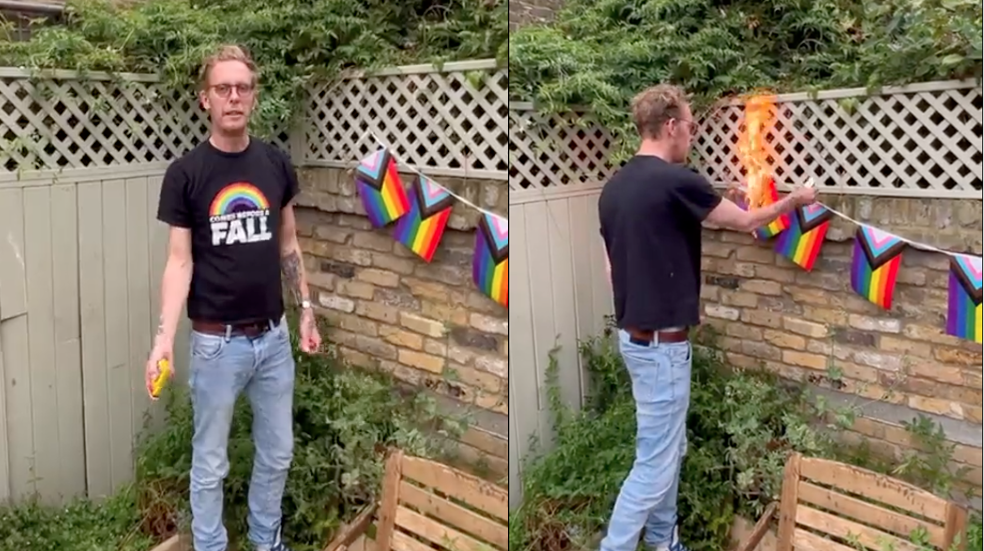
Yet, when one Twitter user called him a “racist prick”, he demanded the user retract the statement and “apologise for any hurt caused,” adding, “You have until 5pm, or I would get yourself a good lawyer.” He then continued to threaten the user with legal action via a series of public and Direct Messages on the app. Who’s the “snowflake” now?
He also attempted to sue another three people over tweets also accusing him of racism in a case that he subsequently lost. It seems that Mr Fox believes that free speech should include incitement to violence but not to calling him racist.
Douglas Murray
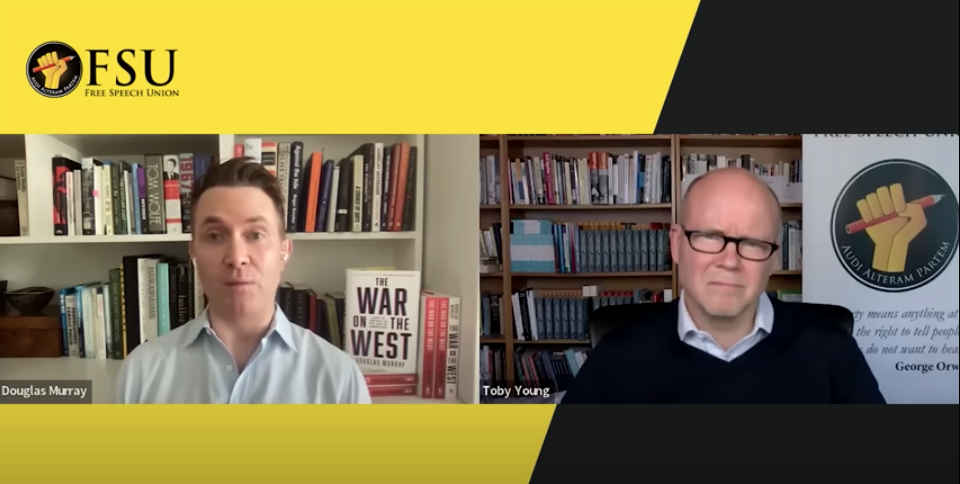
Another notable free speech hypocrite is right wing journalist for the Sun and Spectator, Douglas Murray. Murray is a Director of the Free Speech Union, a “mass-membership public interest body that stands up for the speech rights of its members and campaigns for free speech more widely,” run by Toby Young, a journalist with a history of espousing eugenics.
In the past Murray sued the journalist Sunny Hundal for libel, forcing him to issue an apology and pay him damages. He later published a nasty article in The Spectator crowing about getting to go through Hundal’s current and future earnings so as to “reach some reasonable financial settlement.”
This was something of a habit for Murray who has also issued aggressive legal threats to HOPE not hate in the past in relation to something we published about him. A former colleague of Murray’s at the Henry Jackson Society has also claimed that he was pressured into removing a blog critical of Murray after he was informed that “Murray would otherwise sue me for libel.”
Murray’s hypocrisy is made all the clearer by a speech he gave many years ago to The Lawfare Project, in which he lamented the use of legal threats by Muslims to shut down criticism. Specifically highlighting claims of defamation, he bemoaned how critics of Islam “are being prosecuted and subjected to very often exceedingly flippant and deliberately time-wasting legal practises and legal exercise to stop us pointing out this truth.” So, if someone legally threatens a person he agrees with it’s an outrage, but it’s fine for him to use the same tactic to silence those who criticise him?
Cancel Culture and Nigel Farage
It is often around the issue of Islam and Muslims that this hypocrisy is most evident. Many of those who shout loudest about protecting free speech also have a history of seeking to limit the speech of Muslims they disagree with.
The far-right extremist Milo Yiannopoulos, for example, who recently hit the headlines for collaborating with Kanye West in his antisemitic presidential campaign, is a great example of this hypocrisy. “I try to think of myself as a free speech fundamentalist, I suppose the only real objection, and I haven’t really reconciled this myself, is when it comes to Islam. […] I struggle with how freely people should be allowed to preach that particular faith [Islam] in this country.” At least he has admitted his hypocrisy.
Someone less keen on admitting his hypocrisy is Nigel Farage, who has spent the last few weeks convincing anyone who will listen that he is the victim of a vast establishment crusade following the closure of his Coutts’s bank account.
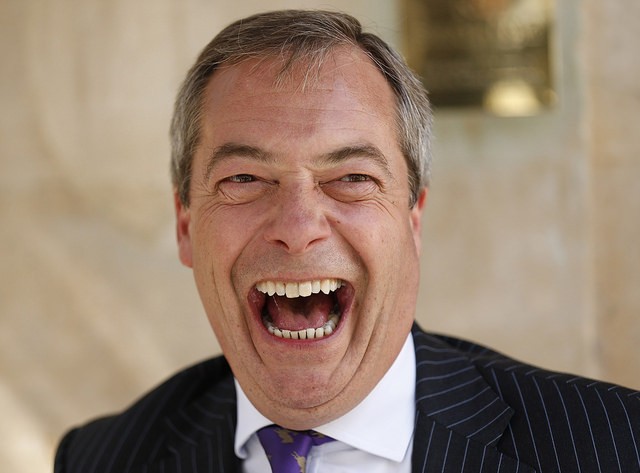
Whatever the rights and wrongs of the closure, the fact that Farage has framed it as a free speech issue is telling. Speaking to The Sun, Farage said, “It is difficult to sue the BBC but I am considering all options of what I do next, including legal action against Natwest.” This absurd situation was ironically summed up by the subheader of an article in The Times reading: “Lenders told to respect free speech as arch Brexiteer threatens to sue.”
He has subsequently led a campaign, enthusiastically backed by much of the right-wing press, that has successfully called for a series of people involved to lose their jobs. There is an obvious contradiction between building a career on opposing “cancel culture” while simultaneously spearheading a campaign for the whole board of Natwest to be sacked because they did something legal that you disagree with. It seems cancel culture is a scourge on society, unless it is being demanded by Farage.
In all of these cases, the issue is not whether the statements in question are accurate or true. It’s the hypocrisy of claiming to be warriors for free speech, endlessly shouting “cancel culture” and bemoaning when people are called out for prejudiced or discriminatory statements, while simultaneously threatening legal action when faced with what they deem to be unfair or inaccurate claims. You can’t have it both ways.
We Must Protect Free Speech
Despite all the disingenuous and contrived declarations around free speech, there is something we can agree on: Free speech has to be defended and we have to fight for it.
Whether there should be limits around free speech and what those limits might be is an important debate, but it is one that is being distorted and side-tracked by hypocrites, who instrumentalise free speech as a way to limit people’s ability to criticise them.
All too often, those who talk most regularly about protecting free speech, actually want the removal of consequences for racist, misogynist or anti-LGBT+ rhetoric but the power to legally threaten and bully those who challenge them.
Many of those condemning the supposed clampdown on free speech fundamentally underestimate the potential for social inequalities to be reflected in public debate, and seem ignorant to the nature and extent of these inequalities in the so-called “marketplace of ideas”.
Except for genuine absolutists, most people agree there has to be some limits to free speech. Tools such as hate crime legislation and the ability to ‘deplatform’ hateful figures from social media we actually increase the ability for a wider range of people to exercise their free speech, especially from minority and persecuted communities, in our public debate.
The position of many of these ‘free speech’ advocates is ultimately contradictory. They claim to be committed to valuing equal free speech above other values, while simultaneously propagating an unequal debate that further undermines the free speech of those who are already harmed by social inequalities (often minority groups).
Begging the question, who are the real “enemies of free speech”?
Prefer to listen? Click the play button to hear the audio version. Harry Shukman Reform UK is staffed by oddballs and enigmas, but none odder…
HOPE not hate reveals the key figures behind Raise the Colours, exposing their criminal histories and their intimidation of local people. Unite the Kingdom attendees…
By Paul Kershaw and Sarah Hadley On a deleted social media account, Reform UK’s candidate in the upcoming Makerfield parliamentary by-election, Rob Kenyon, made creepy…